

 Português - Brasil
 Español
 English
Business First: My Biggest Takeaways from 4CIO Private Sectors

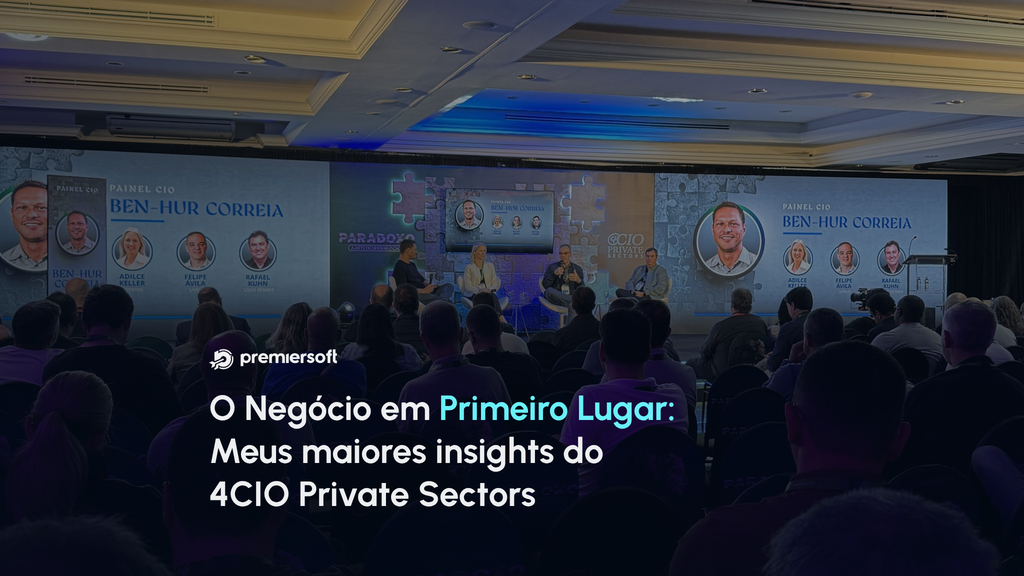
I spent four days at 4CIO Private Sectors in Foz do Iguaçu, and came back with a clearer conviction than I expected: the hard part of AI in business is no longer the technology. It’s the business’s ability to make good decisions about it. Where it belongs, what it depends on, what’s expected of it, and who’s accountable when something doesn’t go as planned.
The first thing that caught my attention was what wasn’t up for discussion. No one there was still asking whether adopting AI was worthwhile, and the numbers confirm what I heard in the hallways: according to McKinsey’s State of AI 2025, 88% of organizations already use AI in at least one area of their business.
The event’s theme was Paradox: The Art of Leading Through Chaos, but the phrase that best summed up the atmosphere came from a technology executive at a financial cooperative client: “excellent chaos.”
Technology has never been more accessible, and for that very reason, the advantage is no longer about access. It’s about the ability to choose where to apply it.
I want to share the insights that stayed with me most. And it’s worth reading to the end, because I’ve included some really interesting data.
Making decisions without a map
The opening keynote was delivered by Emanuel Pessoa, with a question that stayed with us throughout the event: how do you make decisions when the global landscape changes radically every six months? He also pointed to a disconnect that, once you see it, you can’t ignore: the landscape changes in months, but the contracts we sign today commit the company for years.
That took me straight back to the time when I worked in engineering. A construction project takes well over a year to get off the ground, and in the meantime, input costs change, client needs change, and sometimes even the laws change. The plans that worked were the ones that left room to adjust course without bringing down what was already in place.
In conversations with technology leaders, this idea had a very concrete name: lock-in—the dependence on a single vendor, model, or format that becomes expensive and slow to reverse. Interestingly, that very concern gave rise to PRISMON, the solution we presented at the event. Internally, we felt the question firsthand: how can we get the best out of each model without losing the freedom to change course? After more than fifteen years of technology consulting, working on the assumption that something will need to be replaced as the business changes is almost second nature to us. PRISMON was born out of applying that same consideration to our own use of AI.
I left that talk convinced that the advantage lies less in making the right prediction and more in making decisions that hold up when the context changes. And those kinds of decisions tend to have something in common.
The business comes before the tool
That was exactly the tone of a conversation with a CIO in the agricultural sector and a Premiersoft client. The topic was AI in agriculture, but he started with the producer: what improves profitability for those working in the field, and what changes in the cooperative’s operations? AI always came up as a means, never as the main topic.
It sounds obvious, but anyone who works in technology knows how easy it is to get that order reversed. In our rooms in Foz, we deliberately chose to save the demo for later and open every conversation with a question: “Are you satisfied with the level of visibility and governance over AI use at your company today?” Few people were, and what came out of those conversations was far richer than any presentation.
A finance executive at 4Network added to the discussion: the solution almost always starts “with someone on the front lines” who deals with the problem every day. According to MIT NANDA, only 40% of companies have purchased an official AI subscription, but employees at more than 90% of them already use personal tools at work.
To me, this is one of the most interesting changes happening right now: AI no longer enters companies only through the IT department. It also comes in through the desk of someone solving a concrete problem. And that’s great news! Based on the many experiences I’ve had in the market, the best ideas tend to come from close to the operation.
But this changes the role of technology leadership significantly going forward.
Where the machine steps in—and where it stops
This new role is less about choosing the tool and more about setting direction and making it clear how far each use can go.
That “how far” was at the heart of a panel on algorithmic leadership, led by a specialist in AI applied to journalism and decision governance. Instead of the usual debate about reducing headcount, the question was what makes sense to delegate to a machine and what should remain a human decision. Three ideas stuck with me:
Just because something can be automated doesn’t mean it should be. The decision depends on the context and the role that activity plays in the business.
Delegating execution doesn’t eliminate accountability. Someone is still responsible for the criteria and the consequences.
Leadership includes drawing boundaries: where AI can act on its own, where it needs supervision, and where human judgment is essential.
You wouldn’t believe how many times a client has come to us asking to “automate this process with AI,” only for the most valuable conversation to turn out to be about something else: figuring out whether the process made sense as it was and where we could strengthen both the use of technology and the way the business operates as a whole. Often, the final project looked different from the original request, but the value it generated exceeded every prior expectation. And that’s the kind of conversation I enjoy most.
But drawing that boundary raises a difficult question: how do you do that when, most of the time, we still don’t know what will work?
Experimenting with a method
The most honest answer I heard came from an industry technology director: “A company needs to be able to experiment more than once, learn from what went wrong, and let go of the expectation that every initiative will deliver immediate results.” The same idea came up from another angle on the algorithmic leadership panel: what’s holding adoption back most today isn’t a technical limitation; it’s the pressure to get it right the first time.
I strongly agree, and would add one thing: the problem is rarely making a mistake. It’s making one without knowing what you wanted to learn from the test.
The numbers help put this in perspective. McKinsey shows that close to two-thirds of companies still haven’t been able to take AI beyond the pilot phase, and only 39% can point to some impact on business results. Gartner had already predicted that at least 30% of generative AI projects would be abandoned after proof of concept by the end of 2025, and now estimates that more than 40% of AI agent projects will be canceled by 2027. In both cases, the reasons are the same: rising costs, insufficient risk controls, and, above all, unclear business value. MIT reaches a similar conclusion: most pilots that don’t move forward run into a poor fit with day-to-day work, much more than issues with model quality.
In other words, what’s usually missing isn’t technology; it’s sound judgment. I see this often: many requests that come to us have already been through a test that everyone approved at kickoff, but months later, no one can say whether it worked, because no one defined what success would look like. The freedom to make mistakes works better when a few criteria are agreed on in advance:
What do we want to learn?
What business problem does this solve?
How much time and investment make sense?
What evidence would justify continuing?
Under what circumstances do we stop and move on to another hypothesis?
When the scope, timeline, and cost of a mistake are agreed on, it stops being a threat and becomes information.
“Don’t put on the brakes—enable it safely”
The phrase came from a CIO in the industrial sector, during a conversation with Premiersoft’s leadership about his biggest concern with AI today. It sums up the balance almost everyone there was looking for: we can’t wait for AI to stabilize, but it also doesn’t make sense to adopt everything just because it’s available.
It’s worth remembering that AI’s greatest value isn’t always in cutting costs. Often, it’s in the time saved between having an idea and bringing it to market. It’s no coincidence that, according to McKinsey, the companies capturing the most value use AI to grow and innovate, not just to improve efficiency.
But to enable it safely, you first need to see what’s already happening. And that’s where the real numbers from 4CIO Private Sectors surprised me.
The numbers from technology leaders—and what I’m taking away
During the event, we collected data from 59 companies that visited our rooms. Here’s the picture that emerged:
7 out of 10 (41 of 59) rank AI governance as a high or top priority for the next six months.
More than half (33) don’t have a defined process for testing a new AI capability.
Fewer than 1 in 5 (11) have someone in IT dedicated to the topic.
Only 15% (9) could fully audit AI use and the data involved over the past 90 days.
In other words, for every company that can see what AI is doing inside the organization today, there are more than four that consider it a top priority.
This isn’t anyone’s failure. It’s a snapshot of a technology that entered companies faster than they could get organized, and the technology leaders at the event are far from the exception. In Brazil, Netskope reports that 52% of people using generative AI at work still rely on personal accounts. Gartner says that 69% of companies suspect or already have evidence that employees are using unauthorized AI tools. And IBM’s Cost of a Data Breach 2026 shows the price of this: unauthorized AI is already involved in 43% of data breaches, more than double the 20% reported the previous year, and 68% of affected companies still hadn’t finalized an AI governance policy.
If I had to sum up 4CIO Private Sectors in one sentence, it would be this: the AI race is no longer about who adopts first, but who can see, decide, and sustain what they’ve adopted.
Technology will keep changing, and fast. New models will appear, costs will fall, and what seems advanced today will become standard. What never goes out of style is each business’s ability to choose wisely where AI fits, how it’s monitored, and what’s expected of it. That’s what will set apart those who use AI from those who truly capture value from it.
And that’s what motivates me most every day: helping organizations make that decision, even when it shows that the priority lies somewhere else.
Thank you to the technology leaders for their candor, to 4Network for creating an environment for sharing ideas, and to the Premiersoft team working behind the scenes.
Bring on the next one!
 Premiersoft
 Yasmim Savana
 Yasmim Savana